
Best Motorcycle Riding Gear for Canada: Commuter's Guide
Last Updated: November 7, 2026
Quick Summary
The best motorcycle riding gear for Canada is CE-certified clothing built for cold, wet commutes: a CE AAA jacket, AAA or AA jeans with Level 2 knee and hip protectors, plus a certified helmet, palm-protected gloves and reinforced boots. Buy certified pieces you'll actually wear daily, then layer for rain and temperature swings.
- EN 17092 grades garments into classes A, AA and AAA, with higher classes demanding more abrasion resistance.
- The Adelaide fieldjacket is CE AAA with D3O Ghost shoulder, elbow and back protectors included.
- Cafe Racer jeans cost $389.00 in AAA; Warrior jeans cost $309.00 in AA, both with Level 2 knee and hip protectors.
- A full kit of Cafe Racer jeans, Richmond jacket and Adelaide fieldjacket totals $1,607.00.
- Remove all protectors before washing, wash cold and gentle, and never tumble dry protective garments.
Table of Contents
- What Commuters Need From Motorcycle Riding Gear
- How to Read CE Ratings on Motorcycle Commuting Gear
- The Best Motorcycle Jacket for Commuting: Fieldjacket, Hoodie or Shirt
- Motorcycle Jeans with Armor: Cafe Racer vs Warrior
- Waterproof Motorcycle Riding Gear and Layering for Wet Weather
- Helmets, Gloves and Boots: What Your Riding Gear Doesn't Cover
- Dress Codes, Changing and Storing Gear at the Office
- Budget Tiers and Cost Per Ride
- Caring for Protective Gear So It Lasts
- Build Your Commuter Kit at Resurgence Gear
- Frequently Asked Questions
What Commuters Need From Motorcycle Riding Gear
The best motorcycle riding gear for Canada starts with one question: what does your commute actually demand? Cold mornings, wet pavement, and a dress code waiting at the other end. At Resurgence Gear, we build motorcycle riding gear around that reality, because a jacket that only works on the bike is a jacket you'll leave at home.
Protective clothing has real potential to reduce abrasions and lacerations in a crash, according to peer-reviewed research led by D. Wu. That protection only counts if you wear it daily.
Here's what earns a place in a commuter kit:
- Abrasion resistance across the whole garment, not just patches
- CE-rated armor at shoulders, elbows, hips and knees
- Weather protection for rain and wind without overheating
- Off-bike looks that pass in an office or café
- Comfort over 20 to 60 minutes, twice a day
Below, we break down how to read ratings, which garments suit which commute, and how to build a kit that works year-round.
How to Read CE Ratings on Motorcycle Commuting Gear
A CE rating tells you a garment passed a standard test. It does not tell you where the protective material sits. That distinction matters more than most shoppers realize.
EN 17092 is the European standard for motorcycle rider protective garments, and it grades clothing into classes A, AA and AAA. Higher classes demand more abrasion resistance. A label showing the motorcycle pictogram, EN 17092 and the class is your proof of certification. No label means no certification, whatever the hangtag promises.
Here's where buyers get caught: a jacket can pass a class by reinforcing only the zones the standard maps out, then using ordinary fabric everywhere else. Riders slide on their back, chest, forearms and sides, and the contact point moves during a long slide. A patch protects only the area it covers.
Check three things before you buy:
- The sewn-in CE label and its class
- Whether protection is a full lining, a single-layer fabric, or sewn-in panels
- Whether impact protectors are included or sold separately
For a deeper walkthrough of lined versus single-layer construction, see our guide to choosing motorcycle jeans.
The Best Motorcycle Jacket for Commuting: Fieldjacket, Hoodie or Shirt
The best motorcycle jacket for commuting is the one you'll wear without thinking. We make three styles for three different mornings, and all three carry CE AAA certification.
Adelaide Motorcycle Fieldjacket: The All-Weather Option
Waxed cotton outer, a waterproof membrane, and single-layer PEKEV® Ultra Lite reinforced in impact zones. The Adelaide is CE-certified to EN 17092 Class AAA with D3O® Ghost shoulder, elbow and back protectors included. Four utility pockets hold a phone, wallet and gloves.
It's the pick for wet, cold commutes where you want a jacket that looks like a field jacket, not riding kit. Spot clean only, and re-wax periodically to keep the water beading.
Best for: year-round commuters facing rain. Skip if: you want something you can machine wash weekly.
See the Adelaide fieldjacket's full specs and sizing.

Richmond and Wellington: Hooded Protection for the Office
The Richmond Hooded Motorcycle Jacket uses single-layer PEKEV® Ultra Lite, CE AAA certified, with a Tencel fleece hood and an extended rear cut for coverage in the riding position. D3O® Ghost protectors at shoulder, elbow and back come included.
The Wellington Hooded Motorcycle Sweater is the warm-weather sibling: breathable high-tenacity nylon with cotton fleece, PEKEV® lining in key impact zones, and RE ZRO® Flat Level 2 shoulder and elbow protectors included. It runs roomy, so size by chest measurement.
Check the Richmond hooded jacket's rating and included armor.

Kingston Shirt: The Lightest AAA Layer
The Kingston Motorcycle Shirt is a single-layer PEKEV® Ultra Lite overshirt, CE AAA certified, with RE ZRO® Flat Level 2 shoulder and elbow protectors included and a back protector pocket. It's the lightest AAA option we make and the easiest to wear into a meeting.
Review the Kingston shirt's construction and protectors.

Motorcycle Jeans with Armor: Cafe Racer vs Warrior
Motorcycle jeans with armor split into two jobs: the Cafe Racer handles full-length AAA protection, the Warrior delivers AA protection at a lower price. Both include Level 2 knee and hip protectors.
Feature |
Cafe Racer |
Warrior |
|---|---|---|
Price |
$389.00 |
$309.00 |
CE class |
AAA |
AA |
Outer |
12oz selvedge denim |
Promodal® stretch denim |
Lining |
Full PEKEV® waist to ankle |
PEKEV® Lite, full length |
Fit |
Regular slim, tapered |
Tapered with stretch |
Protectors |
RE ZRO® Level 2 knee and hip |
RE ZRO® Level 2 knee and hip |
The Cafe Racer's full PEKEV® lining (32% aramid, 68% UHMWPE) runs from waist to ankle. The Warrior's stretch denim moves more freely and costs less.
Compare the Cafe Racer jean's fit and certification.
Waterproof Motorcycle Riding Gear and Layering for Wet Weather
Waterproof motorcycle riding gear works best as a system, not a single jacket. Canadian riders deal with rain, wind and temperature swings in the same week, and MotoCanada's gear guidance lists water resistance, breathability, venting and removable thermal liners among the factors worth checking.
Our layering approach:
- Base layer: moisture-wicking, thin, tucked in
- Mid layer: fleece or thermal, removable as temperatures climb
- Outer: a water-resistant shell like the Adelaide, or a waterproof over-jacket for heavy rain
- Extremities: waterproof gloves and boots, covered next
Ventilation matters as much as waterproofing. A shell that traps sweat leaves you cold at the office. Look for pit zips or breathable membranes, and avoid non-breathable rain suits for anything longer than a short hop.
Helmets, Gloves and Boots: What Your Riding Gear Doesn't Cover
Your jacket and jeans cover the torso and legs. Three items finish the kit, and none of them should be an afterthought. This is also where vague marketing does the most damage, because a helmet or a boot either passes a test or it doesn't.
Helmets. A full-face helmet protects more of your head than an open-face design, and the chin bar is the part your jaw will thank you for. Fit is a test, not a guess: the shell should sit snug with no pressure points, the cheek pads should press gently against your face, and the chin strap should hold firm when you shake your head side to side. A helmet that lifts or rotates when you push up on the front edge is too loose.
Look for a recognized safety certification label inside the shell as your proof. A helmet without a certification label is a costume, whatever the price tag says. Replace a helmet after any impact, even one that looks minor.
Gloves. Your palms hit first in most falls, so palm protection is the priority. Look for palm sliders or reinforced palm panels, knuckle protection, and a secure wrist closure that won't peel off in a slide. Waterproof gloves for wet months, ventilated gloves for summer, and a thin liner for cold mornings. A glove that fits well but has no abrasion layer on the palm is a fashion glove.
Boots. Ankle protection, a reinforced sole and a gear-shift pad are the basics. Motorcycle-specific boots beat fashion boots because they resist abrasion, hold your foot in place on the peg, and keep the sole from folding under your foot in a low-speed tip-over. Look for a boot with a reinforced toe box and a sole that grips wet pavement.
The George Institute's Gear Study noted that, apart from helmets, evidence on protective clothing's injury reduction has historically been limited. That's a reason to buy certified gear, not a reason to skip it. A certified helmet, gloves with palm protection and proper boots are the three items where the certification and construction are easiest to verify before you buy.
Watch out: a helmet bought online without trying it on is the most common fit mistake. Sizing charts vary by brand, and a loose helmet will not protect you the way it was tested.
Dress Codes, Changing and Storing Gear at the Office
The office is where most riding gear fails. Not in a crash, but in the lobby. If your jacket looks like a race suit, you'll change clothes every morning and eventually stop riding. The fix is a routine, not a better jacket.
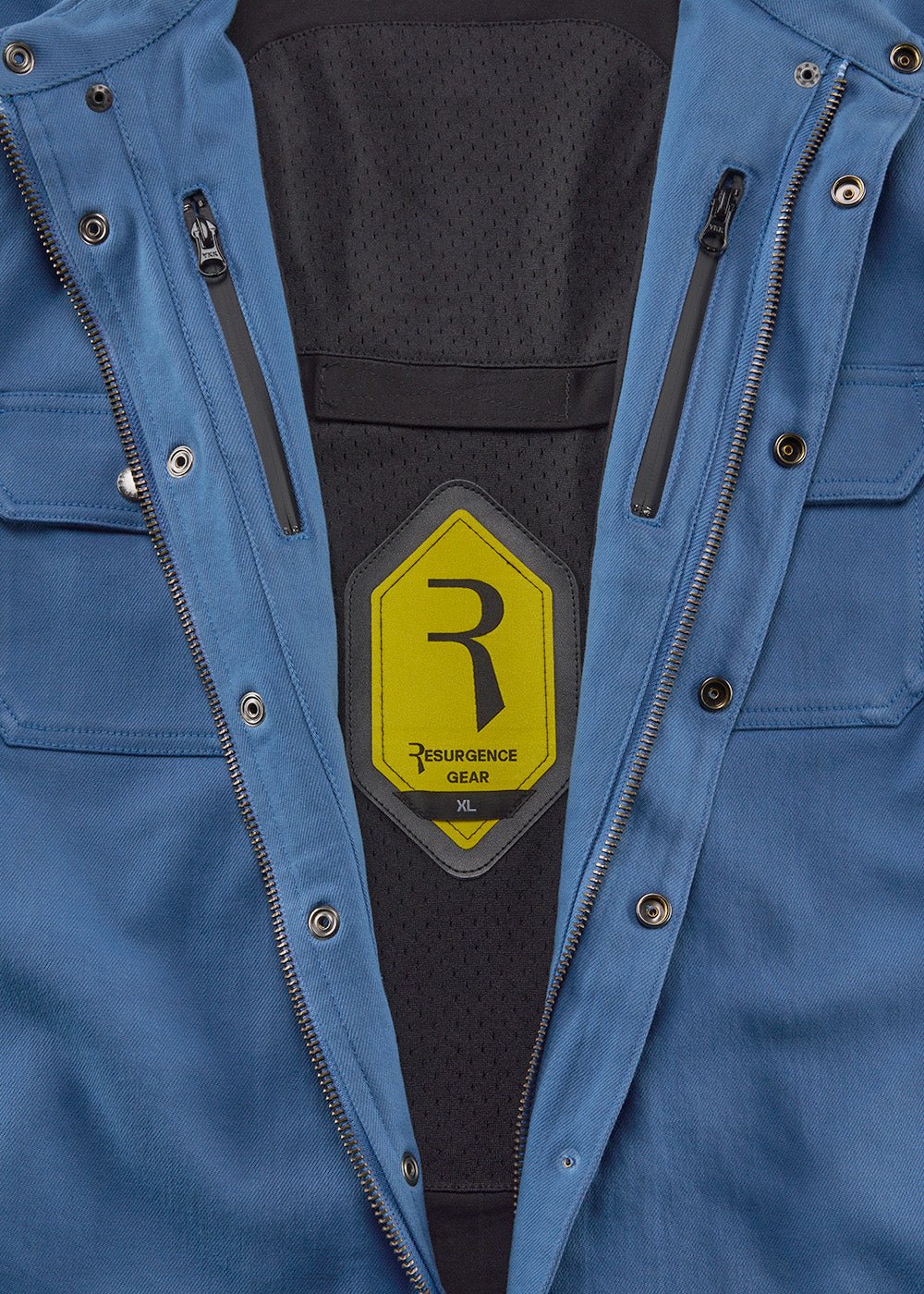
Match the kit to the dress code. A business-casual office tolerates the Kingston shirt, Richmond jacket and Cafe Racer jeans as-is. A formal office needs a different plan: wear a thin base layer under the riding jacket, carry a folded shirt or blouse in a garment bag, and change in the washroom or a locker room. A uniform workplace with limited changing space rewards gear that reads as outerwear, a field jacket over a polo, for example, so you remove one layer instead of changing everything.
Build a desk kit. Keep a locker or drawer stocked with a spare shirt, deodorant, a lint roller, a folding bag for the helmet, and a small towel for wet days. A second pair of shoes at the desk means you can wear proper riding boots and swap into office shoes in seconds.
Change quickly. The fastest routine is to remove protectors first, then the jacket, then swap shoes. Protectors are the giveaway, and most take seconds to pull out. Hang the jacket on the back of a chair or a hook rather than draping it over a desk, and fold jeans along the seam so they don't crease.
Store gear so it dries. A wet jacket stuffed into a bag grows odor and degrades the membrane. Hang it where air can move around it, and pull the liners out to dry separately. A helmet goes on a shelf or in a bag, never on a hot radiator.
Keep work clothes clean. Carry work clothes in a separate compartment or garment bag so road grime and wet gear don't touch them. A wrinkle-release spray and a quick hang in the washroom steam does more for a folded shirt than an iron you don't have.
A common mistake is buying one jacket for everything. A second, lighter layer for warm days costs less than a car park space and keeps you riding. The riders who stick with it are the ones whose gear fits the building they walk into, not just the bike they ride.
Budget Tiers and Cost Per Ride
Spending on gear is easier to justify when you divide it by rides.
Tier |
What it covers |
Example pieces |
Total |
|---|---|---|---|
Entry |
Lower body protection |
Warrior jeans |
$309.00 |
Core |
Jeans plus a light top layer |
Warrior jeans, Kingston shirt |
$758.00 |
Full |
Jeans, top layer and wet-weather shell |
Cafe Racer jeans, Richmond jacket, Adelaide fieldjacket |
$1,607.00 |
Total
Start with the garments you'll wear most. For most commuters that's jeans and a jacket, in that order. Add the wet-weather shell once you've committed to riding through the shoulder seasons.
Caring for Protective Gear So It Lasts
Care is where cheap gear and good gear separate. A garment is tested new, and washing, sun and years of use can degrade the protective layer or wear through the lining. The fix is simple: follow the care label and remove protectors before every wash.
PEKEV® protection is permanent and does not wash out.
Basic routine:
- Remove all protectors before washing
- Machine wash gentle, cold water, mild detergent
- Never tumble dry; hang or lay flat
- Skip bleach and fabric softeners
- Spot clean waxed cotton instead of washing it
Odor management matters for daily wear. Air garments overnight rather than washing after every ride.
Build Your Commuter Kit at Resurgence Gear
The gear that protects you is the gear you actually put on. That's the whole argument for buying certified clothing that looks like your everyday wardrobe: fewer excuses, more rides, better protection every time you swing a leg over.
We make our own protective fabrics, starting from patented PEKEV® fibre, and every garment is CE-certified to EN 17092 at Class AA or AAA. Impact protectors come included, not sold separately. Free shipping across Canada.
Start with the piece you'll wear most, add layers as your commute demands, and check the CE label on everything you buy. That's how you build a kit that earns its place by the door.
Ready to stop choosing between looking professional and riding protected? Resurgence Gear builds CE-certified jackets, shirts and jeans with PEKEV® protection and included RE ZRO® or D3O® armor, shipped free across Canada. Get started with Resurgence Gear and build a commuter kit you'll actually wear every morning.
Frequently Asked Questions
What motorcycle gear do I need for commuting?
A commuter kit starts with a CE-certified jacket, CE-rated riding jeans with knee and hip armor, gloves, boots with ankle protection, and a certified full-face helmet. Layer for weather: a waterproof shell or a jacket with a built-in membrane for rain, and a thermal base layer for cold mornings. The goal is protection you can wear all day, not gear you change out of at the door.
Are motorcycle jeans with armor protective enough for daily riding?
It depends on the CE class. EN 17092 rates garments from A to AAA, and AAA is the highest abrasion class. An AAA jean such as the Cafe Racer has a full PEKEV® lining from waist to ankle, not just patches, so protection does not stop at a seam. Check the sewn-in label for the motorcycle pictogram and the class before you buy.
What safety ratings should I look for in motorcycle clothing?
Look for EN 17092 on the label with a class of AA or AAA for commuting. The class tells you the abrasion resistance, but not where the protective material sits, so ask whether it is a full lining, a single-layer fabric, or panels in an ordinary shell. Armor should be included, ideally Level 2, rather than sold as an upgrade.
How should motorcycle riding gear fit for a commute?
Riding gear should be close enough that armor stays over the joint when you move, with room for a base layer underneath. Jackets need an extended rear cut for coverage when seated. Try the riding position, not just standing: reach for the bars and check that elbow and knee protectors stay put. Size up between sizes for comfort.
How do I care for waterproof motorcycle riding gear?
Remove protectors before washing, use a gentle cold cycle and mild detergent, and hang to dry rather than tumble drying. Avoid bleach and fabric softeners. Waxed cotton jackets like the Adelaide are spot-cleaned and re-waxed periodically to keep water resistance. PEKEV® protection is permanent and does not wash out, so care is about the outer fabric and armor, not the abrasion layer.